Some deliveries may take a little longer than usual due to regional shipping conditions.

DOWNLOAD THE APP


Customer Services
Copyright © 2025 Desertcart Holdings Limited
DOWNLOAD THE APP
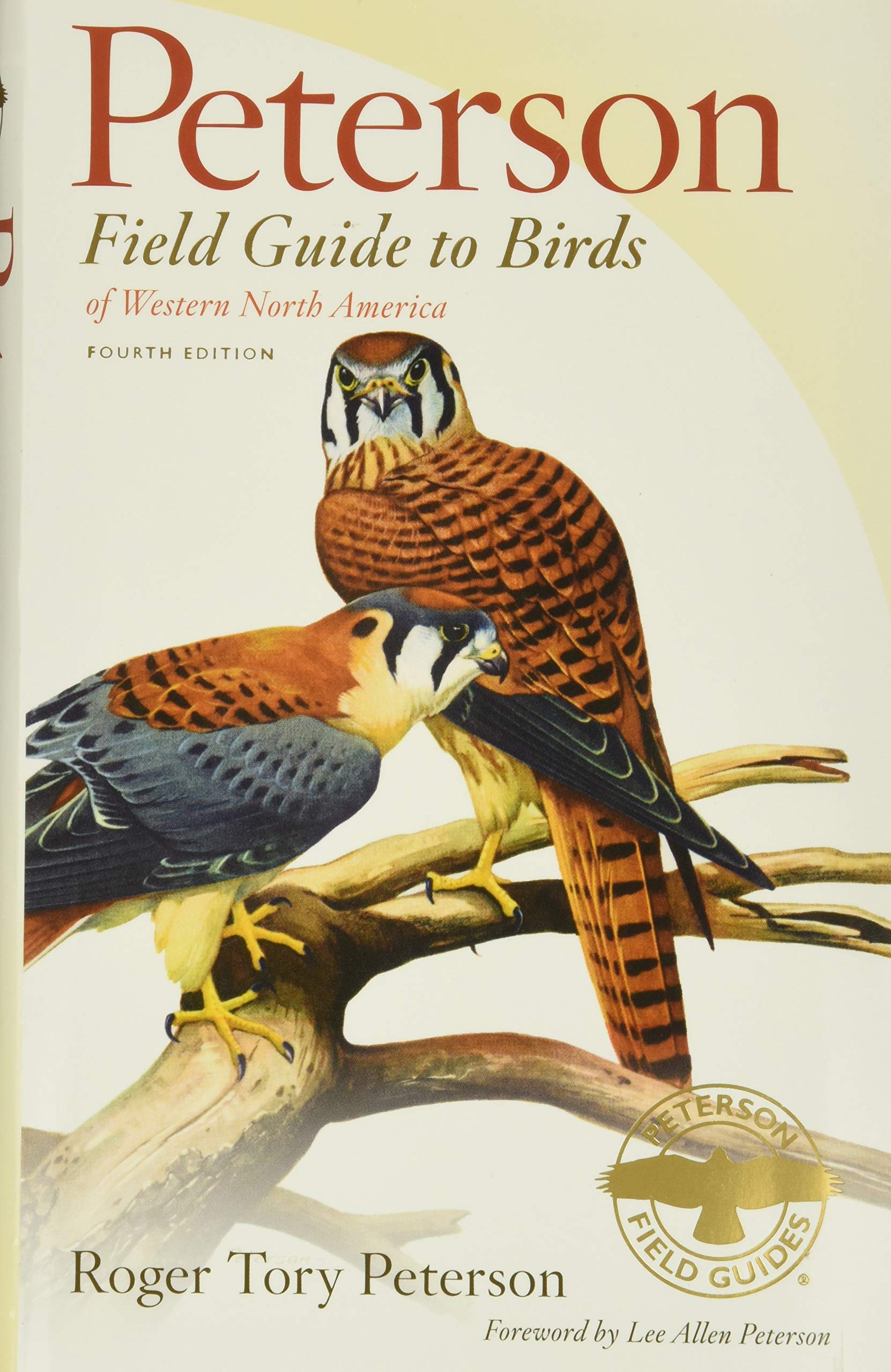
🦅 Spot the Unseen, Own the Outdoors!
The Peterson Field Guide to Birds of Western North America, 4th Edition, is a definitive resource featuring over 600 species with expertly crafted illustrations and detailed field maps. Celebrated for decades, it remains the essential companion for birders seeking accuracy and ease in identification across the western U.S. and Canada.
| Best Sellers Rank | #1,804,456 in Books ( See Top 100 in Books ) #646 in Ornithology (Books) #2,365 in Bird Watching (Books) |
| Customer Reviews | 4.8 out of 5 stars 448 Reviews |
G**E
Best book in the field
This is a lovely book, both as a field guide and as a light scientific reference. The drawing as clear and make it easier to identify birds than photos. There’s a reason this has been THE field guide to western birds for so long. One caveat, given the relatively long period between editions there is some minor outdated information in this book, that has changed since 2010. For example the sparrows are listed in the family Emberizidae, but in 2017 new world sparrows were split off from Emberizidae into their own family Passeridae. These minor flaws aside, and given the low price, I think this book should be the first field guide aquired in any western birder’s library and if I had to pick just one bird book, it would be this one.
I**N
the return of an old friend...
Bird watching was an approved activity in our very conservative home. And the tools used for that was a Bausch & Lomb 7 power binocular and an early edition of the Peterson Field Guide. Its pages were marked and book marks placed at specific spots so that when a bird was spotted the guide could be quickly referred to. The book was a valued piece of literature to my parents and eventually myself. I wish I had that copy now as a tangible reminder of positive moments spent with my parents in the field. I have my own copy now, the Peterson Field Guide to Birds of Western North America - the fourth edition, and I keep a copy in my truck so that I can use it as a reference in the field. The utility of this edition is improved by the addition of field maps across from each bird profiled. This edition also includes maps in the back to add just a bit more information that may be helpful in narrowing down variables when making identifications. Since I have experience with the Peterson guide(s), I have a preference for them. However, I can highly recommmend both the smaller Sibley Field Guides and the National Geographic Bird Guides and I use both - especially the Sibley for reasons that are beyond the scope of this review. I recommend this guide - especially for beginning birders and believe they remain quite useful as you develop more field experience.
B**W
Life-long Love for the Peterson Guide
There is a stack of bird books sitting near the window in my living room from which I watch a bird feeder and its visitors every day. I have an ancient 2nd edition of Peterson that really started me watching birds. So, I admit that I have a sentimental attachment to my Peterson Guides. I have hauled Peterson Guides over 4 continents. The National Geographic Guide is a back up for me, when I am trying to compare characteristics of the birds I see. Sibley I keep for comparison and because I love books-and as a general U.S. Guide. But, day-to-day, year-to year, I still carry my Peterson in a knapsack with my maps and snacks and use it as my comfortably dog-eared companion. I also love this new addition. Although it is a bit larger, it is still smaller that my Sibley guide. It also has some of the improvements that made the Sibley guides popular, such as maps on the same page as the bird illustrations. (Another reviewer has complained the maps are not accurate, but I must admit that I only use the maps as a very general reference. The bird migration and shifting populations seem to make the presence of many birds "outside the map" a real possibility where I live). The larger illustrations are a real improvement (much appreciated as my eyes age). The biggest difference for me, after years of birdwatching, is that the Peterson Guide is only one of the sources I consult. Now I carry a field guide but am more likely to take field notes and sketches home to look at more than one source. Perhaps because I studied art when I was young, I prefer the less constrained illustrations by Peterson vs. Sibley. All in all, the Peterson Guide is still the one I will carry with me in the field as the quick reference. I have often heard that Peterson is not for "serious' birders. Well, it has served this amateur well for several decades. The new addition is a delight. It is not prefect, there is no perfect; but if I were to recommend one guide to western birds, this would be the one.
K**P
Very Conclusive
This book lays out the birds in a way that I guess I'll just have to get used to. There is a reason for its organization. Unlike a Sibley's guide, the book lays out all the birds of a similar type perched, and then a drawing of the the bird from the top during flight. Then later in that section, they show the same birds from the bottom during flight. A Sibley's guide dedicates a whole page or two, to a bird and shows all of its angles in one spot. This is simply a matter of preference. I also noticed that the biogeography of the birds differed from Sibley's to Peterson's so I'll leave that up to you decide who you think is more accurate.
D**S
Peterson still the best for bird ID!
Sure there is lots more competition from other bird books now; but for ID of birds Peterson is still the best! The use of "points of emphasis" drawings to distinguish what makes a species different is still the best technique and biggest help - even for experienced birders (and I fit this category knowing warblers by their song). Do not go with books that use photographs whatever you do - birds just do not look like the photo in real life; as there is significant variation by bird. But a few characteristics are prominent on all birds of the same species - thus, Peterson drawings emphasizing these prominent points are the most helpful approach. Also, do not try to make a reference book with more info into a "field guide" for ID - too much info is bulky and confusing and harder to reference "in the field". RTP is still King and his legacy lives on...
D**R
All the information that you need.
Incredibly illustrated, this book provides detailed visual information about the distinct markings found on the male and female of each species, along with the juvenile stage in many cases. As many species within a group are very similar in appearance, this book provides the necessary information to accurately identify the birds you are encountering. Provides range maps, as well, indicating the winter, summer and year-round ranges of each species. There is a small map inset amongst the paragraph of information, as well as a handy reference number directing you to a larger map in the back of the book. Overall, I regard this book as a must-have for novice and avid bird watchers alike.
K**D
Big improvement over earlier edition
We have several Sibley and Peterson guides in our kits. While I love Sibley's illustrations, I've always found the Peterson's guide easier to use in the field. But the location of range maps in the back was always a major complaint. This edition retains the range maps in the back but also includes them in the description pages throughout the book. It also includes a convenient life-list checklist in the back. It is the same size as my old Peterson's so it fits in all the same pockets as before. This is a welcome upgrade and I was glad to get it.
W**N
A sentimental favorite guide updated.
What is not to like about the Peterson Bird Guides? I grew up with an old edition and updated recently. There are many guides out there, but in my opinion this one is the most instantly usable and portable, easy to take with me while birding. And besides, I grew up with the book, it has helped me for 50 years, it will always be a book I recommend.
Trustpilot
1 week ago
4 days ago